How Tesla FSD Detection Could Transform Insurance Claims, Risk Scoring, and Accident Verification
FleetBold’s Tesla FSD detection system introduces a new layer of trip intelligence for insurance claims, fraud mitigation, risk scoring, and accident verification by identifying when Full Self-Driving was used during Tesla trips.

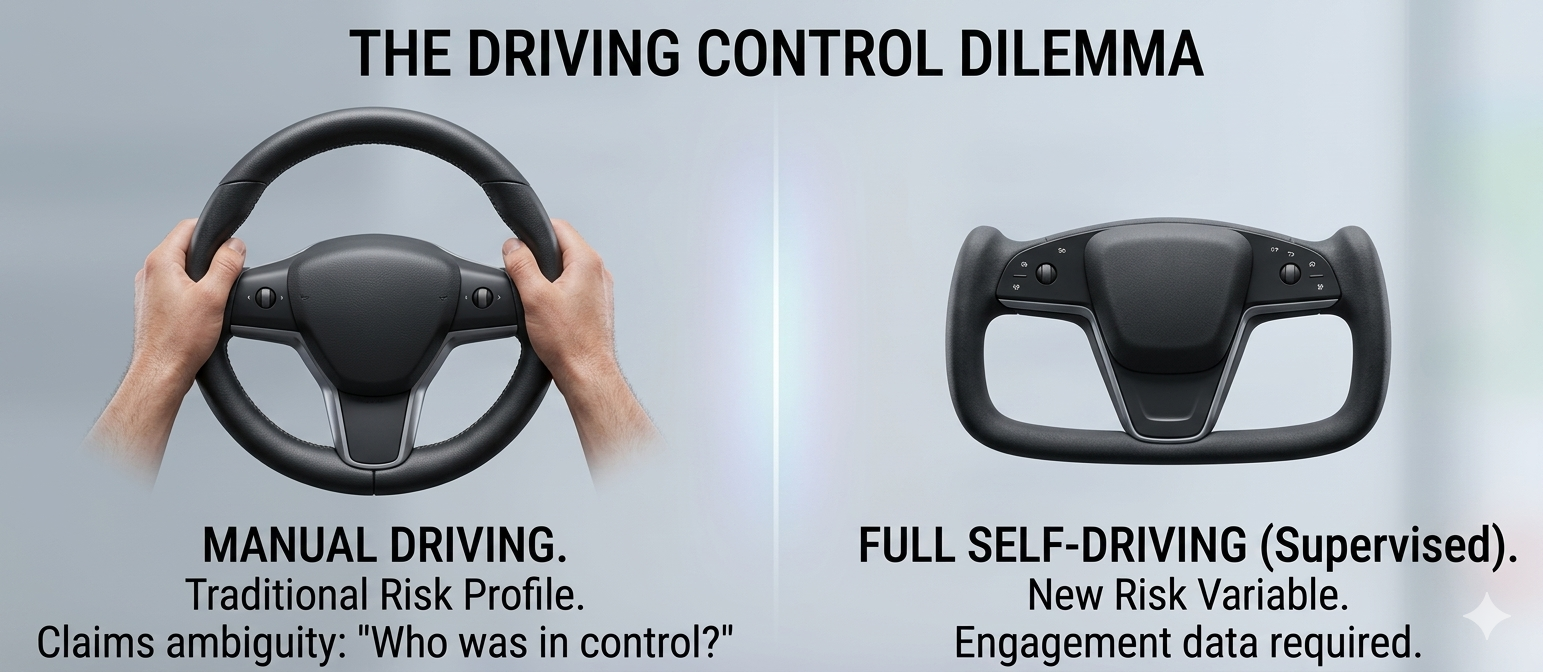
Insurance has always depended on context. A claim is never just about where a vehicle was located or how fast it was moving. It is about what happened, when it happened, who was in control, and whether the story being told matches the available evidence. For years, telematics helped insurers answer part of that question by measuring mileage, speed, location, acceleration, harsh braking, and driving patterns. But Tesla Full Self-Driving introduces a new risk variable that traditional GPS tracking was never built to answer: was the vehicle being driven manually, or was supervised autonomy active?
That question is becoming more important as Tesla vehicles become more common across rental fleets, commercial operators, peer-to-peer platforms, private rental businesses, and mobility insurance programs. A driver involved in an incident may say, “the car was driving itself.” A renter may claim Full Self-Driving caused the vehicle to behave in a certain way. A fleet operator may have GPS history, trip distance, and timestamps, but still lack the most important layer of context: whether FSD was actually being used.
FleetBold is now moving its Tesla Full Self-Driving detection system into testing. The first version is designed to detect whether FSD was used during a Tesla trip and display that activity visually inside the trip record. This gives insurance teams, risk partners, and mobility operators a new way to understand not only where a vehicle traveled, but how the vehicle was being controlled during the trip.
This is not just GPS tracking. It is the beginning of autonomous driving intelligence for insurance.
Why Tesla Full Self-Driving Creates a New Insurance Question
Tesla Full Self-Driving, commonly known as FSD, is one of the most recognized advanced driver assistance systems in the market. Tesla describes Full Self-Driving (Supervised) as a system that can assist with lane changes, navigation, turns, traffic interaction, and other complex driving tasks under driver supervision. Tesla also makes clear that Full Self-Driving (Supervised) does not make the vehicle autonomous and that the driver must remain attentive and ready to take over.
That distinction is extremely important for insurance. When a driver says, “the Tesla was driving itself,” that statement does not automatically explain the event. It does not confirm whether FSD was active, whether it was active during the entire route, whether the driver took over before the incident, or whether the behavior happened during manual driving.
For insurers, claims teams, underwriters, and fleet risk managers, the real questions are more specific. Was FSD active during the trip? Was it active during the part of the trip where the incident happened? Did the driver disengage FSD before the event? Did risky behavior happen immediately after manual control resumed? Was the vehicle operating under supervised autonomy or under direct human control?
FleetBold’s FSD detection is designed to bring visibility to those questions.
The Problem With Claims Based Only on Statements
Autonomous driving creates a new kind of claim ambiguity. Before advanced driver assistance systems became common, many claims focused on traditional questions: speed, location, braking, impact, road conditions, driver behavior, and damage evidence. Those factors still matter, but Tesla FSD adds another layer. Now the claim may also involve the driver’s statement about whether the vehicle was controlling itself.
Imagine a Tesla renter returns a vehicle with damage and says Full Self-Driving caused the incident. Without FSD trip intelligence, the operator may only have GPS location, photos, vehicle condition reports, and the renter’s explanation. That can create a gray area. The driver has one version of the story, the fleet owner has limited visibility, and the insurance team has to evaluate the claim without knowing whether supervised autonomy was actually active.
Another scenario is even more complicated. A driver is involved in a collision and claims they were using FSD at the time. If the trip record only shows location and speed, it may not be enough to validate or challenge that statement. But if the trip data shows FSD was not detected during that portion of the route, the claim conversation changes. It does not automatically decide legal responsibility, but it gives the claims team a stronger technical record.
Fraud and claim disputes often live in ambiguity. FSD detection reduces that ambiguity.
What FleetBold’s Tesla FSD Detection Does
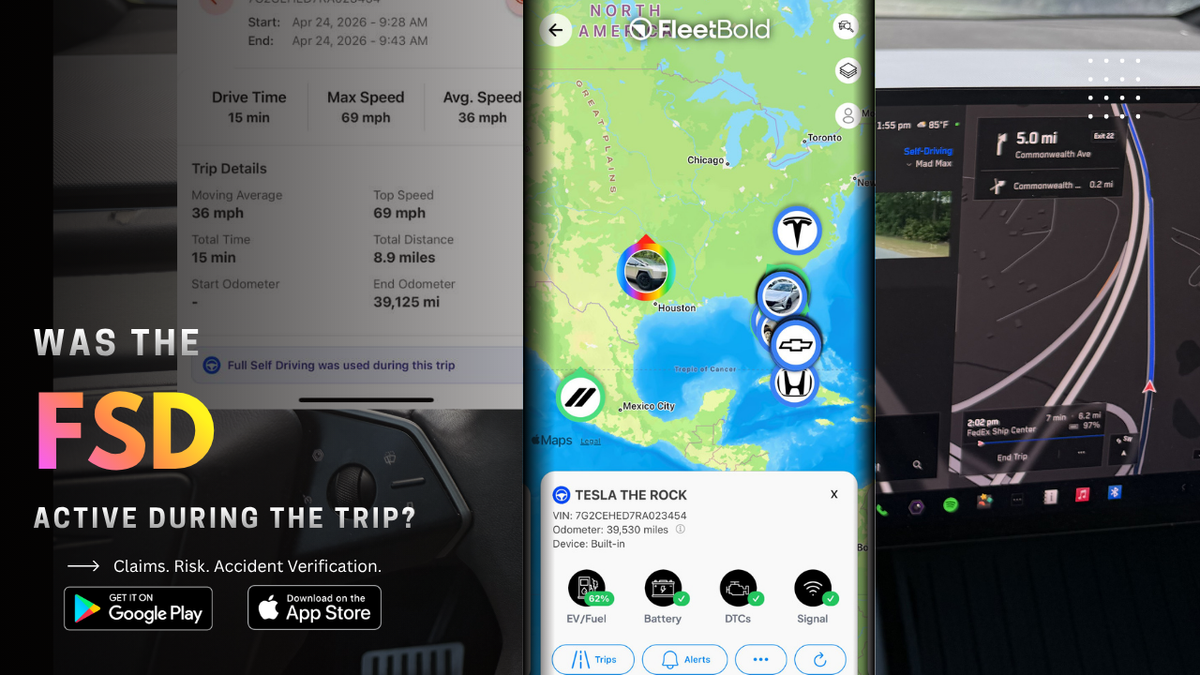
FleetBold’s Tesla FSD detection system is designed to identify when Full Self-Driving was used during Tesla trips and display that information inside the trip history. In Version 1, FleetBold will be able to show whether a trip included FSD activity and visually mark that activity on the trip map.
That means an insurance partner, claims reviewer, fleet operator, or Tesla rental business can open a trip and see more than a route. They can see where the vehicle traveled, when FSD activity was detected, and how that activity fits into the broader trip timeline.
This changes the value of telematics. A regular GPS tracker can show where a vehicle went. FleetBold is building toward a deeper question: how was the vehicle being controlled?
That difference matters. Location is useful, but location alone does not explain control context. Speed is useful, but speed alone does not explain whether the vehicle was operating under supervised automation or manual driving. Trip history is useful, but trip history becomes much more powerful when it includes autonomy data.
FleetBold’s FSD detection turns Tesla trip history into a more complete technical record.
Event-Level FSD Verification: The Next Layer
FleetBold is also testing a deeper layer of FSD intelligence designed for event-level verification. The goal is to help identify whether FSD was active at or near a specific event timestamp. That event could be a collision, a damage claim, a harsh braking event, a sudden stop, a customer dispute, a vehicle abuse concern, or any moment where the insurance team needs more precise control-state context.
This is where the insurance value becomes much bigger. Knowing that FSD was used during a trip is valuable, but the most important insurance question is often more exact: was FSD active at the moment that matters?
That moment could be the second before impact. It could be the moment before a lane departure. It could be the moment before a sudden stop. It could be the point where a driver claims the system made a decision. It could be the part of the trip where the renter says they were not responsible because the vehicle was “driving itself.”
FleetBold’s current testing is moving toward that level of high-confidence event context. The purpose is not to replace adjusters, legal review, or professional accident reconstruction. The purpose is to add a stronger technical layer to the claim file.
Why This Matters for Claims Validation
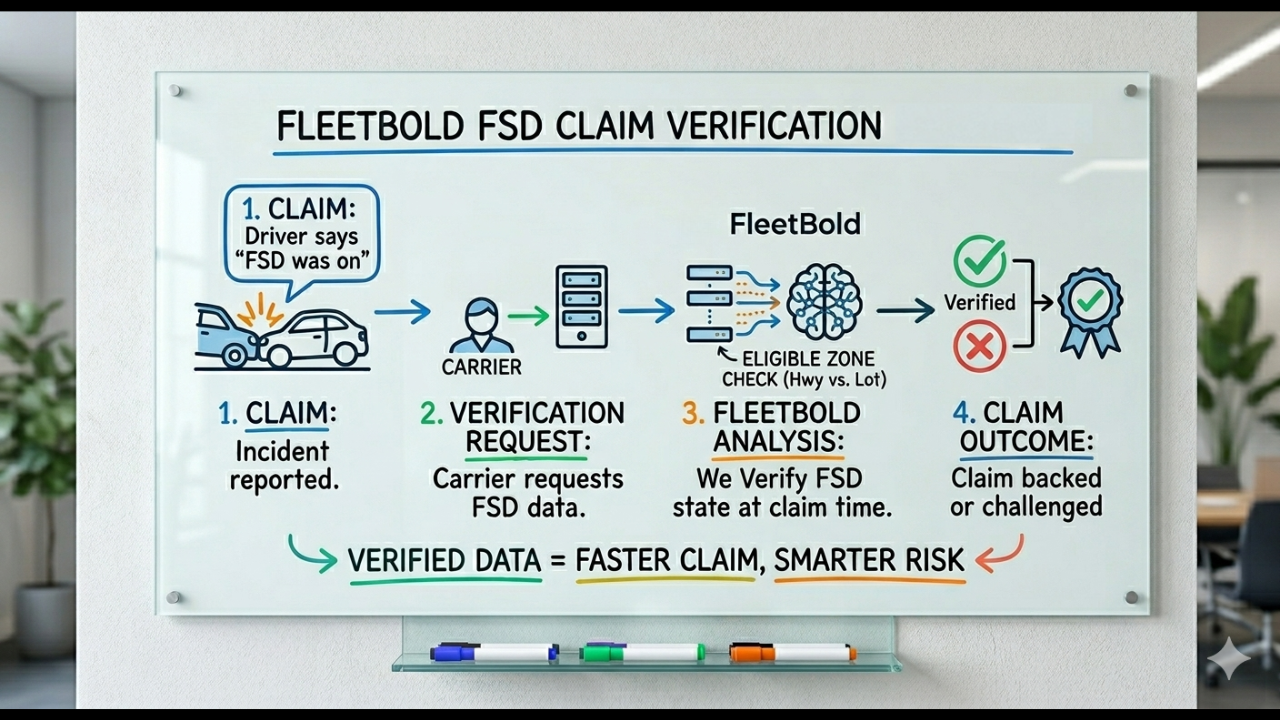
Claims validation depends on timelines, evidence, and consistency. A driver statement is important, but it should not be the only source of truth when the vehicle itself can provide deeper context. If a driver says FSD was active during an incident, FleetBold’s trip intelligence can help review whether that statement aligns with the data.
If the data shows that FSD was not detected during the relevant portion of the trip, that gives the claims team a clearer basis for questioning the explanation. If the data shows that FSD was active, that also matters because it adds autonomy context to the review. In both cases, the value is the same: better information, fewer assumptions, and a stronger trip record.
FleetBold does not determine legal fault or liability. That decision belongs to insurers, adjusters, investigators, attorneys, courts, and the applicable policy language. What FleetBold provides is technical trip data that can support claims review, internal investigation, customer dispute resolution, and accident analysis.
In insurance, better data does not eliminate judgment. It improves the quality of the judgment.
Why This Matters for Fraud Mitigation
Fraudulent or exaggerated claims become easier when the facts are incomplete. A renter can blame the vehicle. A driver can say the system made a decision. A customer can claim they were not manually driving. Without FSD detection, those statements can be hard to validate.
FleetBold’s FSD detection helps reduce that blind spot. When FSD usage is visible on the trip map and connected to trip timestamps, claims teams can compare the driver’s statement against the trip record. If someone claims the car was driving itself, but the trip record does not show FSD activity during that period, the claim becomes easier to challenge. If FSD was active, the review can focus on what happened before, during, and after that autonomy-assisted segment.
The point is not to assume fraud. The point is to reduce ambiguity. Insurance teams do not need more opinions. They need better context.
The more advanced vehicles become, the more important it becomes to separate what a driver says from what the trip data supports.
Risk Scoring and Underwriting in the FSD Era
FSD detection is not only useful after an accident. Over time, it can become an important risk variable for underwriting, pricing models, fleet insurance programs, mobility insurance, and usage-based insurance.
Traditional telematics risk models often focus on mileage, speeding, harsh braking, rapid acceleration, night driving, route patterns, location risk, and driver frequency. Those signals still matter, but FSD introduces a new category: autonomy usage behavior.
For example, an insurer may eventually want to understand whether FSD is mostly used on highways, in city environments, during long-distance trips, or in higher-risk areas. Claims and risk teams may want to compare harsh braking events during manual driving versus FSD-assisted segments. They may want to identify whether certain drivers disengage frequently, whether risky behavior happens immediately after FSD turns off, or whether specific trip types create more control transitions.
This does not mean FSD is automatically safer or riskier in every situation. The stronger point is that insurers need data to study the difference. FleetBold’s FSD detection helps create the foundation for that analysis.
The insurance industry is already moving toward deeper visibility around advanced driver assistance systems and automated driving systems. NHTSA’s Standing General Order requires certain manufacturers and operators to report specified crashes involving Automated Driving Systems and SAE Level 2 Advanced Driver Assistance Systems, showing how important system-engagement context has become in the broader safety and regulatory environment.
For insurance, that same direction is clear. The future of risk scoring will not only ask where a vehicle went or how fast it moved. It will ask what systems were active, when control changed, and how the driver behaved around those moments.
Accident Verification and Reconstruction
Accident review is about building a timeline. Where was the vehicle? How fast was it moving? What happened before the incident? Was there braking, acceleration, a sudden maneuver, or an unusual stop? Was the driver in control? Was an advanced assistance system active?
FleetBold’s FSD detection adds another layer to that timeline. For Tesla vehicles, knowing whether Full Self-Driving was active during the trip, and eventually whether it was active at or near a specific event timestamp, can help insurance teams and operators understand the control context surrounding the incident.
This is especially important in rental and fleet environments, where the vehicle owner is often not the driver. A private owner may know how they personally use FSD, but a rental operator has different risk exposure. Every trip may involve a new renter, a different driving style, a different understanding of Tesla technology, and a different level of responsibility behind the wheel.
FleetBold does not replace professional accident reconstruction. It adds a new data layer that can support the reconstruction process.
Why API Alone Is Not Enough
APIs are valuable, but API-only systems are limited. Insurance-grade intelligence needs a broader data strategy because no single data source tells the whole story.
FleetBold’s approach is built around data fusion. Tesla vehicle data tells one part of the story. FleetBold’s telematics infrastructure, trip reconstruction, and behavior intelligence tell another part. When those layers work together, insurers and operators get a clearer view of what happened.
That is why FleetBold is not treating FSD detection as a simple label inside a trip. The bigger vision is to build a complete Tesla intelligence layer for fleets, rental operators, insurance partners, and risk teams. The map matters. The trip history matters. The vehicle data matters. The behavior before and after FSD usage matters. The timestamp matters.
The future of insurance telematics will not be built on one signal. It will be built on connected data.
Why This Matters Now
Tesla FSD usage is becoming more familiar to drivers, renters, and vehicle owners. Tesla also offers Full Self-Driving as a subscription, which makes access more flexible and increases the likelihood that FSD usage will appear across different ownership and rental scenarios.
That creates a new reality for insurance. Claims teams will see more incidents where the driver mentions FSD. Rental operators will face more disputes involving Tesla features. Underwriters will need better ways to understand how advanced driver assistance affects risk. Mobility platforms will need stronger documentation when vehicle control becomes part of the claim conversation.
The insurance industry cannot evaluate autonomous-era claims with GPS-only tools. It needs trip intelligence. It needs event context. It needs control-state visibility.
FleetBold is building for that future.
The Future of Autonomous Driving Insurance
The future of insurance telematics is not just location. It is context.
As vehicles become more intelligent, insurance data must become more intelligent too. Tesla FSD detection gives insurers, claims teams, and mobility operators a new way to understand whether supervised autonomy was involved during a trip and how that context may affect claims, risk, fraud mitigation, and accident review.
FleetBold is building toward a future where claims are not reviewed only through statements, assumptions, and incomplete trip records. They are supported by driving intelligence.
This is not GPS tracking. This is autonomous driving intelligence for insurance.
FAQ: Tesla FSD Detection for Insurance Claims, Risk Scoring, and Accident Verification
What is Tesla FSD detection?
Tesla FSD detection is the ability to identify whether Full Self-Driving was used during a Tesla trip. FleetBold is building this into Tesla trip history so FSD activity can be reviewed visually on the map and connected to the broader trip record.
Why does FSD detection matter for insurance?
FSD detection matters because insurance claims often depend on understanding what happened during a specific moment. If a driver claims the vehicle was using Full Self-Driving, insurers need better data to review whether that statement matches the trip record.
Does Tesla Full Self-Driving make the vehicle fully autonomous?
No. Tesla describes the current system as Full Self-Driving (Supervised), and Tesla states that it does not make the vehicle autonomous. Drivers must remain attentive and ready to take over.
Can FleetBold determine who is at fault in an accident?
No. FleetBold does not determine legal fault or liability. FleetBold provides technical trip data and FSD usage context that can support claims review, accident analysis, customer disputes, and internal investigations.
Can FleetBold show if FSD was active at the exact moment of an accident?
FleetBold’s first version is focused on detecting and visually displaying FSD usage during Tesla trips. FleetBold is also testing deeper event-level verification designed to help identify whether FSD was active at or near a specific event timestamp.
How can FSD detection help reduce fraudulent claims?
FSD detection helps compare driver statements against trip data. If someone claims the vehicle was driving itself, but the trip record does not show FSD activity during that portion of the route, the claims team has stronger technical context to review the claim.
How can insurers use FSD data for risk scoring?
Insurers can use FSD data as an additional risk variable. Over time, FSD usage patterns, control transitions, driver behavior before and after FSD usage, and event-level context may help insurers better understand risk exposure.
Is this only useful after an accident?
No. FSD detection can support claims, underwriting, fleet monitoring, driver behavior review, fraud mitigation, rental vehicle protection, and long-term actuarial insights.
Is FleetBold only using Tesla API data?
No. FleetBold combines Tesla vehicle data with its own telematics infrastructure and trip intelligence layer. This broader approach helps create a more complete view of how the vehicle was used.
What makes this different from regular GPS tracking?
Regular GPS tracking shows where a vehicle went. FleetBold’s FSD detection helps explain how the vehicle was being controlled during the trip. For insurance, that difference is critical.